Showing posts with label recipe. Show all posts

Friday, June 08, 2012

Cucumber Salad

It is close to bed time and this is usually the time I am brushing my teeth, floss and so on... and the time I am reflecting on the day that just passed. Well, looking back on today I have to admit that I have not achieved much for my caring employer. Never mind. Though the thing I can truly be proud of is that cucumber salad I came up with as side for the slice of tuna Toño made for dinner.


I was torn between crème fraîche and yoghurt as base for the dressing and luckily sided for the latter. It was refreshing and went perfectly well with the tuna as well.

I mixed a plain yoghurt with some apple vinegar and seasoned with sea salt and black and red pepper. Before adding the dressing to the pitted, quartered and finely sliced cucumber, I sprinkled them with chopped dill.

Dinner was served with a Schloss Gobelsburg Grüner Veltliner Tradition 2010.

Friday, March 25, 2011

Pollo al Cuñete

We've reached La Huacana, where we can enjoy the fine cooking by Toño's sister Chilo. The first lunch she served us today was Pollo al Cuñete with pineapple, almonds and dried plums.


Start with a chopped pineapple, dried plums, a bit of water and a bit of white balsamic vinegar. Blend the mixture and pass through a sieve. Fry the chopped chicken in olive oil complemented with a bit of butter. Season every piece with salt and pepper while frying and add some pressed garlic after turning them over. Put the chicken pieces with the sauce in a casserole, add some plums, peeled almonds, a couple of chilli jalapeño, some sugar, peppercorns, marjoram and bay leafs. Put the casserole with a lid on into the oven for 1 hours and 20 minutes at 200C/390F. Remove the lid after 50 minutes.

Yes, I did ask for a second servings.

PS: If you have no peeled almonds, put the unpeeled ones in boiling water. The skin should go off in no time.

Location:Morelos Norte,La Huacana,Mexico

Tuesday, November 23, 2010

Paupiettes in Autumn

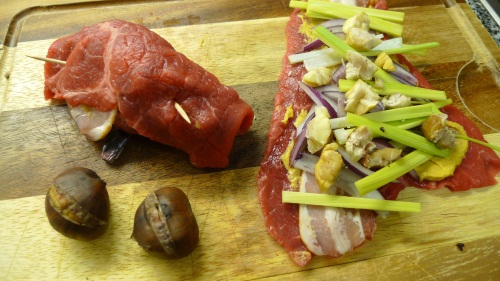
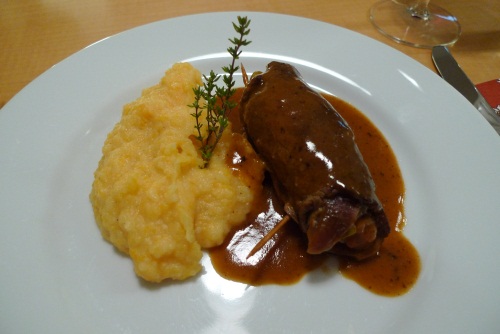
I haven't bored you with a recipe in a while, so I do it again. This time it's for chestnut stuffed paupiettes with mashed pumpkin and potatoes on the side.


I asked my butcher to cut me some thin slices of beef and Toño brought me some roasted chestnuts he got from a street vendor. The slices of beef we smeared with mustard, added a slice of ham, thinly sliced leek and onions, topped it with rough crumbs of chestnut, and seasoned with salt and pepper. Seas Everything was rolled to nice paupiettes.

The paupiettes were briefly fried and then removed, the remains in the pan were used to make the sauce with flour, white wine, beef stock, thyme and rosemary. When the sauce was boiling, the paupiettes and the remaining stuffing was added again and braised for 50 minutes.

For the mashed potatoes, we replaced a third of the mass by pumpkins, which we processed together with the potatoes.

Wednesday, January 06, 2010

Refreshing Chicken Soup

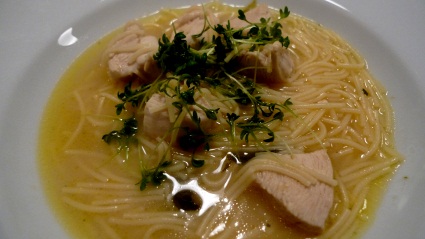
It's January - that is, the waistline has disappeared and the budget is rather tight. So it came in handy that our local supermarket has a 30% discount on chicken breasts :) In other words, it was time for some refreshing chicken soup.


Lemon, mint and sprouts make this an amazingly refreshing soup. Heat 30 g salted butter, zest & juice of half a lemon and the leaves of 2 twigs of mint in a pan. Slice a big chicken breast and add it to the pan. Stir until the chicken turns white. Add half a litre chicken stock and soup pasta. Let it boil on low heat for 10 minutes. Decorate with sprouts of your choice.

Friday, January 01, 2010

Do It Right - Do It Simple

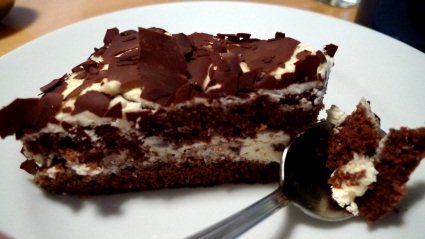
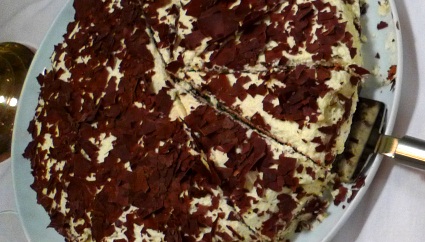
The oldest memory of Black Forest gâteau, I can remember, was my sixth birthday when a piece of it was catapulted from Bruno's spoon into Sigi's ear.


But I must have known it before that, then I'm dead certain that I'd wished to have Black Forest gâteau as my birthday cake for when my school friends came over to celebrate with me.

With the exception of spinach, your mother's version of a dish is usually the benchmark that can hardly be met. So it is at least for me with Black Forest gâteau. All others are usually far over the top - that is, they have cherries added or far to much stuff on the top. My mother went for a simple yet unbeatably scrumptious approach.


My mother does not make it any more but luckily my sister adopted the recipe and recently shared it with me:

Biscuit

Make the biscuit at least one, better two days in advance.

Mix 3 egg and 150 g sugar and it is all bright and fluffy. Fold in 130 g flower and 20 g cacao powder. Pour in a greased springform pan and bake 20 minutes at 200°C/392°F. Let is cool at first in the pan so that the condense water is soaked up by the biscuit and it stays moist.

Topping


Make as late as possible prior to serving the cake.

Cut the biscuit carefully once or twice horizontally. Pour over each biscuit disc a tablespoon of cherry brandy. Beat 500 ml cream until stiff. Smear the cream over the bottom biscuit, add the next layer and continue until the top is cover with cream. Cream also the sides. Add chipped chocolate until the cake looks speckled.

Option

This is not for the purists. In an Indian hotel I saw a White Forest gâteau. For this, substitute the cocoa powder with flower and the black chocolate chips with white chocolate chips. Don't forget to duck down, if a purist tried to throw it into your face.

Monday, December 21, 2009

Chräbeli

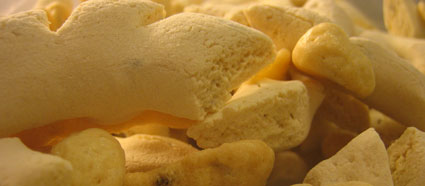
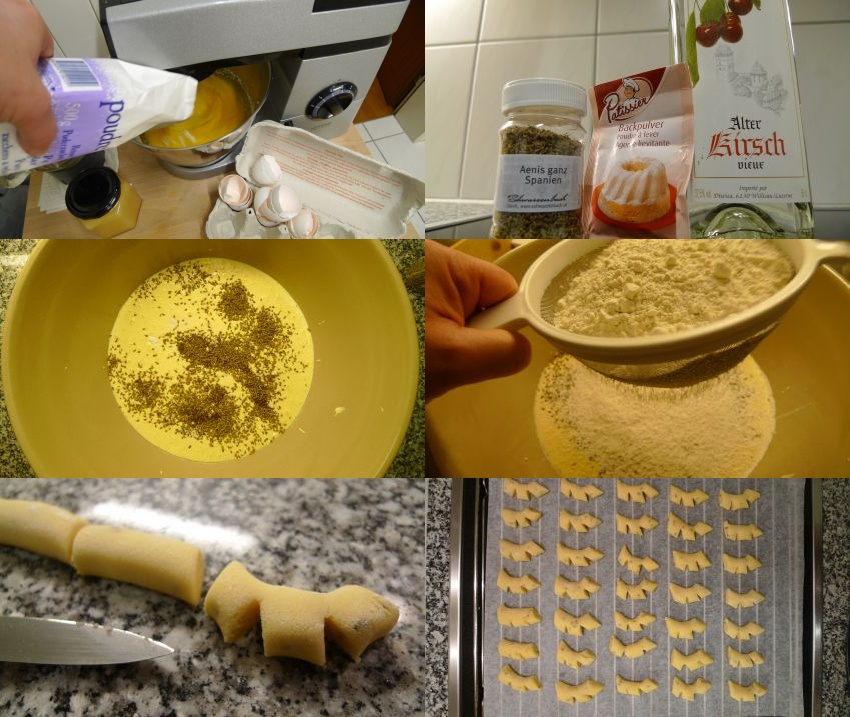
Chräbeli translate to small scratches (the German speaking part of Switzerland uses the diminutive extensively). Probably the name is derived from the serrated shape of the cookies, which might cause scratches. But who cares, I like them because of their aniseed flavour and they are really easy to make.

Ingredients:
  • 500g caster sugar
  • 4 eggs
  • 2 tbsp aniseed
  • a pinch baking powder
  • tbsp cherry brandy (optional)
  • 460 - 500 g flour


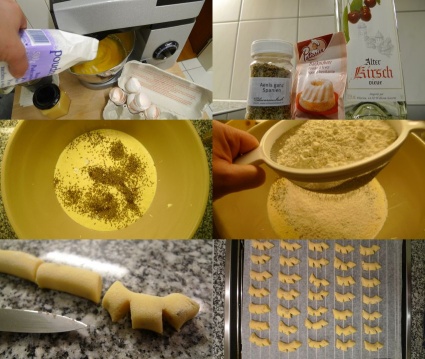
Mix sugar and eggs for about half an hour. Add anise, baking powder and cherry brandy (optional). Sieve flower onto the mixture and mix carefully.

Roll dough to finger-thick rolls. Cut diagonally into 5-7 cm long pieces. On a long-side, make 2-3 diagonal incisions. Bend to a slight horseshoe shape.

Put on a baking tray (with baking paper or greased and flour dusted) and let them rest at a warm place over night.

Bake at low heat (about 120°C/248°F) for 30 minutes. The top has to remain white. On the bottom little "feet" have to grow. If the feet don't appear, they need to rest a bit longer.


Source: Cookbook of the Cooking School Winterthur, published 1949

Wednesday, November 18, 2009

Winterly Chicken

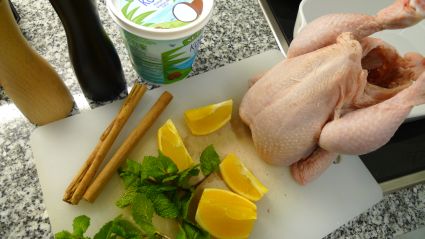
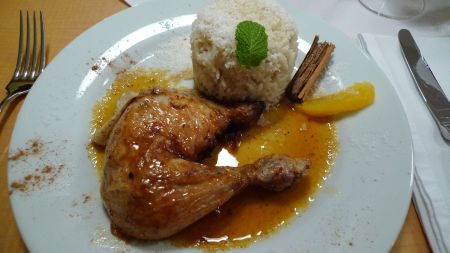
Yesterday evening, Toño went to the gym and I jumped in to make dinner. Epic failure. I have never done that dish (Fasolakia Ladera) before and the recipe was totally flawed. Let's forget it and concentrate on something that actually worked. There is a recipe Toño has not only mastered but also improved significantly: chicken cooked in coconut butter with Ceylon cinnamon and oranges. Last Saturday, I asked Toño to cook it and it blew my taste buds into another sphere.

Everything starts with a slaughtered and plucked chicken of a reasonable size. Dab it dry with kitchen paper. Season the chicken with sufficient freshly ground salt and pepper inside and outside.


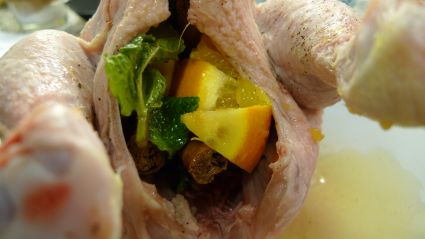
Stuff the chicken with a big knob of butter, 2 cinnamon sticks, 2 twigs of mint, half an orange cut in slices (with peel) and the juice of the other half. Sew up the hole and put the chicken into an oven-proof baking pan. Preheat the oven to 200°C/392°F.


Heat up 60 g coconut butter together with a cinnamon stick. Pour it over the chicken and cook it for 60 minutes in the oven. While in the oven, pour from time to time some coconut butter over the chicken.

Reduce 4 dl orange juice with 1 tbsp orange flower honey* and a knife point of cinnamon in a pan. Cut the chicken in 8 parts. Pour the syrup over the chicken and glaze for 2-3 minutes in the oven.


For the coconut rice side dish add coconut milk to the water when cooking the rice (1 part coconut milk, 6 parts water). Before serving, sprinkle desiccated coconut over the rice.

* Don't compromise on the honey. It must be orange flower honey. It can't be substituted.

Tuesday, November 17, 2009

Russian Plait

I doupt that this cake has anything to do with Russia. I think it's just a name given by to it. At least my sister-in-law Татьяна does not know it (and I don't think it's because she's not really Russian but of Udmurt origin). But segs wies well (as we Swiss say), here is how to make a Russian Plait.

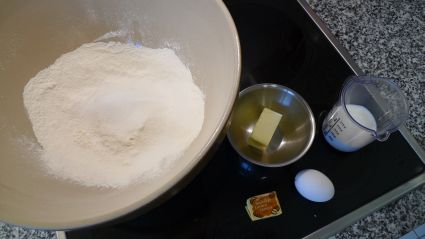
Everything starts with a simple sweet yeast dough: sieve 300 g flour into a bowl, add half a tsp salt, 3 tbsp sugar and 60 g soft butter. Dissolve 20 g yeast in 1 dl milk and add 1 egg. Pour the liquid into the middle of the bowl. Knead to a smooth dough. Let it rest covered at room temperature to double rise.


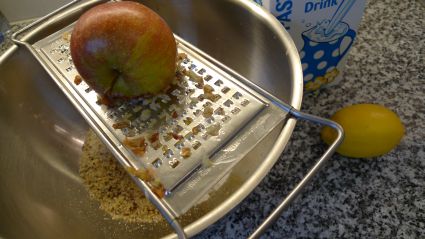
For the filling mix 150 g ground nuts, 3 tbsp sugar, 1 grated apple, zest and juice of half a lemon, 4-6 tbsp milk.


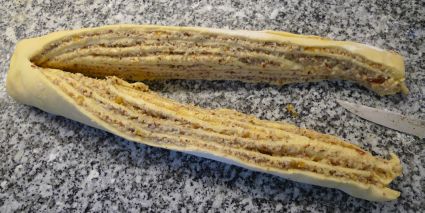
Roll out dough (rectangular, 3 mm thick, 28 cm wide). Spread first some apricot jam onto the dough and then the filling. Roll up neatly and cut almost in half along the roll.


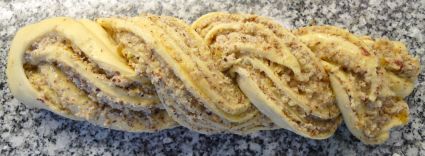
Make a nice plait.


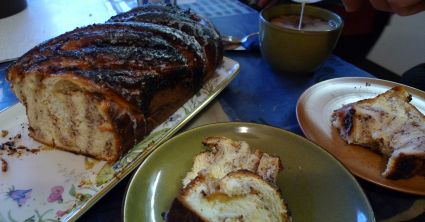
Bake for 30-40 minutes at 220°C/428°F. While still hot, glaze with a icing sugar and lemon juice mixture.

It is recommended to let yeast pastry rest for up to 2 days before serving. This intensifies the flavour (according to my sister, who knos such things).

Wednesday, October 21, 2009

Apple Waie

In a comment to an apple post by MartininBroda, naturgesetz wrote:

there's no better way to use apples than in a good old fashioned simple apple pie — just apples and sugar and pie crust, maybe the lightest touch possible of cinnamon and/or a drop or two of lemon juice, if you must. But it should taste of apples, not a lot of other stuff, and it doesn't need other ingredients to make it "interesting."

We have such a dish that might please naturgesetz' palate. It is called Wähe or Waie, which is Alemannic German. But there are various names for it. I personally call it Dünnle. I only know four other people who called by that name.

Whatever, a Waie is basically a short pastry shell with shallow sides, no top crust, and any of various fillings, such as fruits, cheese or onions.

This is how I make an Apple Waie:

I like baking but I loath making short pastry dough, thus I usually buy it ready made. I like the taste of whole grain flour for this dish, but my supermarket of choice has recently replaced that with an organic white flour version. Meh.

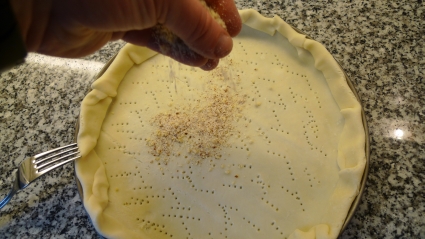
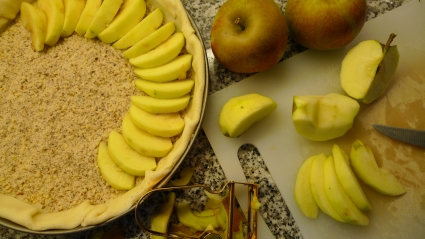
Put the flattened pastry on a buttered baking tray, pull up the edges a little and pierce the dough repeatedly with a fork. Sprinkle a thin layer of ground hazelnuts onto the dough.


Peel the apples, remove the core and cut to thin slices. It is not essential to use a gold-plated peeler, but it feels so much better. For the apples I recommend the Boskoop variety, or any type that is rather tart and keeps its shape when cooked. Arrange the apple slices like a shutter is constructed (or how would you describe this?)


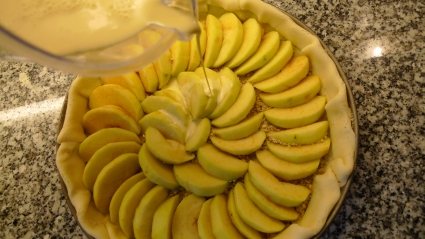
For the filling I use 2 dl of cream, 1 egg, some vanilla sugar and some ground cinnamon. Beat it briefly but firmly before pouring it over the Waie.


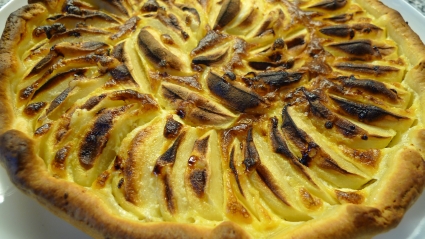
Bake it for 25 to 30 minutes at 250°C/480°F.


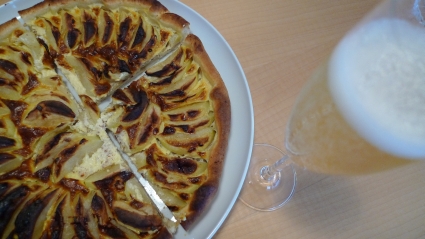
My mother used to serve tea to Apple Waie (this was the only time we drunk tea at home besides of when being sick), however, it also goes perfectly well with some champagne.

Sunday, October 11, 2009

Simple Pleasures - Oatmeal Soup

It is only 7 weeks until my Swiss compatriots will decide whether I will loose my job, be cast out and shoved into the lumpenproletariat*. Thus it seems appropriate to see if there is a life beyond hedonistic indulgence. Like today, when I decided not to go for the traditional Sunday roast and made some oatmeal soup instead.

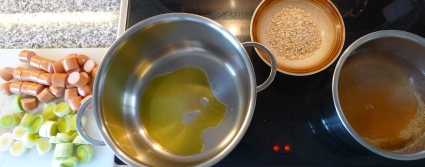
Ingredients for 4 plates:
  • 1 tbsp of oil
  • 3 tbsp of oatmeal
  • 0.8 litre of stock
  • 1 small leek
  • some bangers (which might only be permitted temporarily- to smooth the transition)


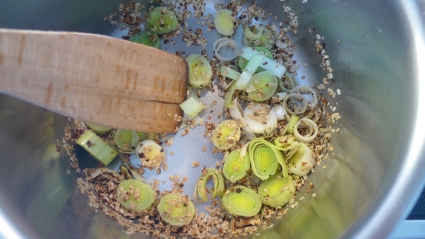
Heat the oil in a pan. Add the oatmeal and fry it for a bit, before you add the chopped leek. Reduce the heat and keep stirring until the leek has softened.


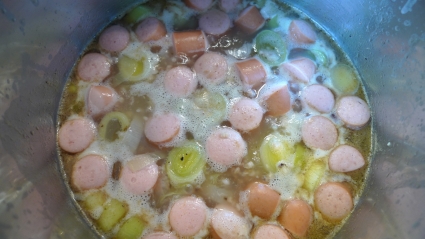
Add the stock. Season and bring to the boil. Reduce the heat, add the chopped bangers and let it simmer for 30 minutes.


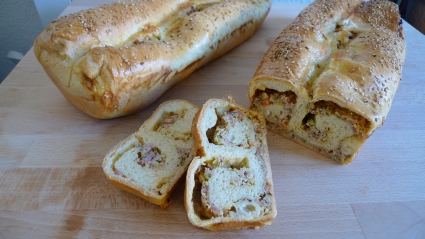
Serve the soup with some bread. You should buy the bread a day in advance since people eat less bread, when it is a bit stale.

* The initiative for an export ban on Swiss arms is on the ballot of the November 29 polling. The other initiative, the Swiss will have to decide on that date is the prohibition of minarets in Switzerland. Both are amendments to the constitution. We Swiss have the tendency to put the weirdest things into the constitution. Like we constitutionally prohibited both Absinthe and the Society of Jesus, nevertheless, both have been legalized some years ago, since we Swiss apparently have gained in strength to withstands such threads to society. However, some seem to think that the Swiss are not quite ready for harmful effects of minarets, and that world peace might suffer due to my ingenious mind.

Wednesday, September 02, 2009

Ham Wrap Cake


Preparation: about 45 minutes
Rising: approx 2 hours
Baking: about 1 hours
Serves 4 or 8 as aperitif

For 1 cake mould of about 28 cm/11 in in length

Baking paper for the mould

Dough:
300 g of flour (⅔ wheat + ⅓ spelt)
3/4 teaspoon salt
15 g yeast, crumbled
1.75 dl milk, lukewarm
60 g butter, liquid & coooled

Stuffing:
250 g ham, very finely chopped
1 spring onion, finely chopped
1 tomato, monder, seeded and cut into small cubes
2 gherkin in small cubes
100 g semi-bold curd cheese
100 g Parmesan cheese or Sbrinz cheese, grated
1 egg, beaten
2 tbsp chopped parsley
1 pinch of curry
Salt
Pepper from the mill
2 tbsp mustard for coating

Garnish:
1 egg, beaten
1-2 tbsp sesame seeds

Mix flour and salt and make a hollow in the middle. Dissolve yeast in some milk. Pour yeast with rest of the milk and the liquid butter into the hollow. Knead to a smooth dough. Let it rest covered at room temperature to double rise.

For the stuffing, mix all ingredients and season.

Roll out dough (rectangular, 3 mm thick, 28 cm wide). Spread mustard mustard onto the dough (leave a 2 cm margin at the sides). Spread the filling onto the mustard. roll the dough from 2 sides toward the middle. Put into the mould, which had been laid out with the baking paper.

Let it rest for 30 minutes at room temperature. Brush with egg, sprinkle with sesame seeds.

Bake for 55-60 minutes at 180 °C/356 °F.

Serve warm or cooled out. Goes well with a mixed salad.

[Source]

Tuesday, September 01, 2009

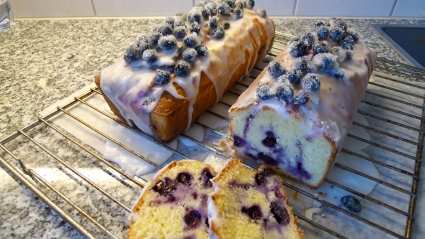
Blueberry Cake


Preparation: about 30 minutes
In the oven: about 1 hours

For 1 cake mould of about 26 cm/10 in in length

Baking paper for the mould

Dough:
260 g flour
40 g cornstarch
2 teaspoons baking powder
200 g sugar
1 pinch of salt
1 packet of vanilla sugar
½ lemon, zest and 2 tbsp of juice
3 eggs
175 g butter, liquid & cooled
1.5 dl buttermilk
150 g blueberries

Garnish:
100 g blueberries
1 egg white, lightly beaten
Sugar

Icing:
200 g powdered sugar
1½ tbsp lemon juice
1-2 tbsp water

Mix flour, cornstarch and baking powder in a bowl. Add ingredients of the list up to the lemon zest. Stir lemon juice, eggs, butter and buttermilk, pour to mixture. Mix to a smooth dough. Add the blueberries carefully. Pour into the mould, which had been laid out with the baking paper.

Bake for 60-70 minutes at 180 °C/356 °F. Let it cool out on a rack.

Garnish: drag berries through the egg white, and then through the sugar. Let them dry on a kitchen paper.

Icing: Mix all ingredients to a thick icing. Pour over the cake. Let it dry a bit and spread some sugared berries on the top. Let it dry.

[Source]

Wednesday, August 26, 2009

Ceviche - The Recipe

There is hardly any Hispanic American country that does not claim that Ceviche is their national dish. The recipe here is by Toño's sister Chilo and is thus a Mexican variant (original recipe).

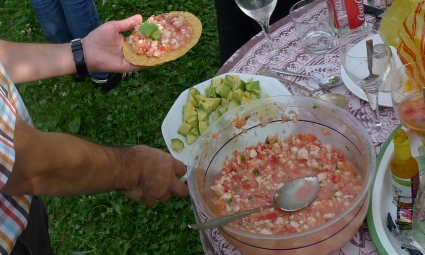
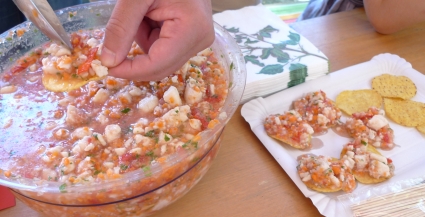
Ceviche is the ideal party finger food. Thus the recipe here serves plenty. Actually it fully fills the bowl in this picture:


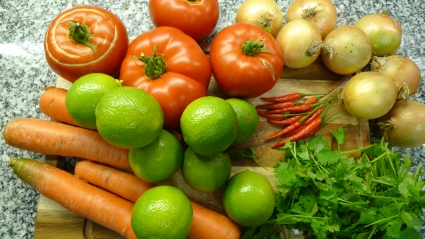
Ingredients:
  • 2 kg freshwater fish fillets
  • 3 large onions
  • 1 kg tomatoes (preferably fully ripe beefsteak tomatoes)
  • 8 limes
  • plenty of coriander
  • 4 carrots
  • 2 garlic cloves
  • 6 chillies
  • 1 bay leaf


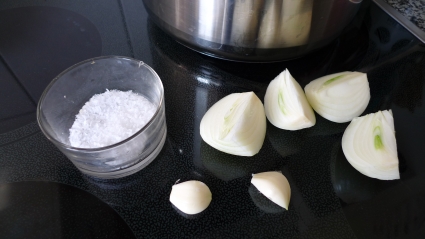
Bring about 2 litres of water to a boil with an onion cut into quarters, two cloves of garlic, a bay leaf and salt.


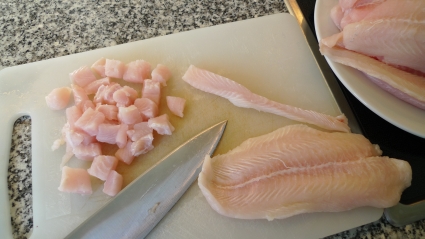
When the water is boiling add the fish fillet, which you have cut into small squares. Let them boil for a minute. Pour off the water and remove all the remains of the onions, garlic and the bay leaf. Let the fish cool down.


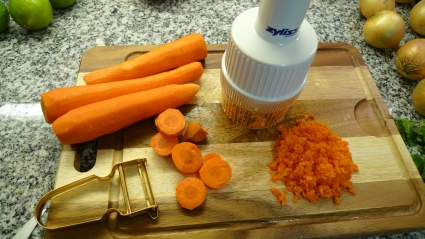
Meanwhile finely chop two large onions (or many small ones). Add the juice of four lime. Now finely chop and add to the onions: peeled carrots, chillies, coriander and the seeded tomatoes.


Do you see the REX Economy Peeler on the left side? It's gilded and a Christmas present by Toño. There is no posher way to peel carrots.

Mix everything together with the cooled out fish. Add the juice of three to four more limes. Season with salt and if you like a couple of tablespoons of olive oil. Stir again and put it into the fridge for at least half an hour.


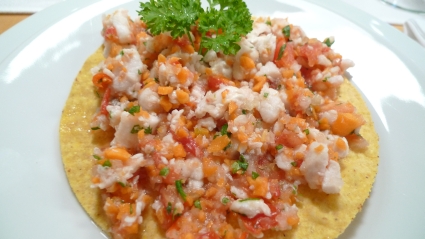
Serve on tostadas. If you like add some cubes of avocado. For those who like it spicy add a few drops of Tabasco sauce or habanero sauce "Maria Dolores". Bon appétit!


The fish ceviche is commonly served in Mexico as part of an appetizer at a barbecue with family. It goes well with a cold beer or dry white wine, e.g. a Riesling, Alvariño or Verdejo. Enjoy!

Saturday, August 08, 2009

Birchermüesli - an Interpretation

Antipo Déesse has asked for the recipe for Birchermüesli. No doubt, a charming lady's wish shall be my command.

Birchermüesli had been invented by Maximilian Oskar Bircher-Benner, who was a Swiss physician and pioneer of whole food. He postulated eating raw fruit, raw vegetables and nuts instead of meat and white bread. He was truly a bit revolutionary for the late 19th century. Dr. Bircher's original recipe goes:
  • 1 tablespoon rolled oats, soaked in 2–3 tablespoons water for 12 hours
  • 1 tablespoon lemon juice
  • 1 tablespoon condensed milk
  • 200 grams apple (about one large, preferably a sour variety), finely grated and mixed with the above directly before serving
  • optionally top with 1 tablespoon ground hazelnuts or almonds

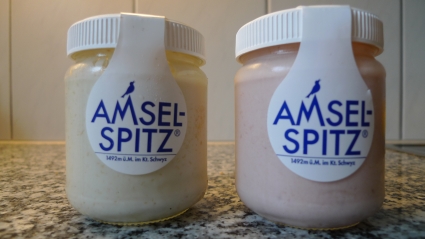
I've slightly modified this recipe to my preferences. I usually start with some yoghurt.


This could be plain or with fruits. If it's plain, you might add some sugar too. Fruit yoghurt has usually already sugar in it. Some people use cream or whipped cream, but i.m.h.o. it tastes so much fresher with yoghurt.

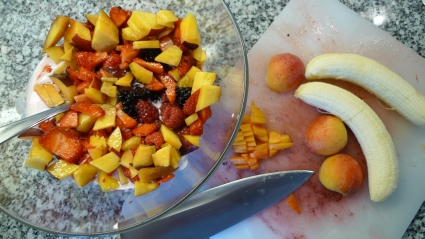
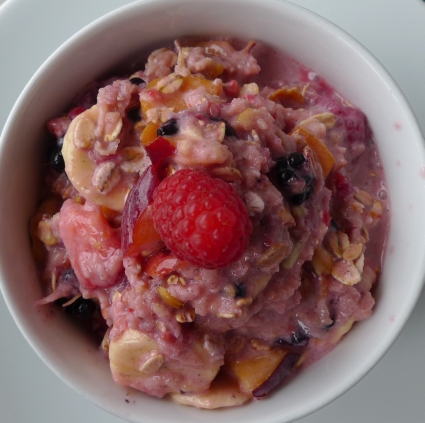
Then I add plenty of finely cut seasonal fruits and berries. Today I took blueberries, blackberries, strawberries, raspberries, apricots, nectarines and bananas. You might also add some lemon juice. Then the fruits don't oxidate.


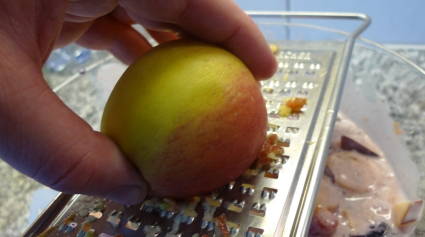
You can use whatever fruits you like. However, grated apples are mandatory. Use a sour variety when possible. Some slobs do not grate the apples but finely cut them. This is definitely not my thing. I like my muesli to be smooth.

#

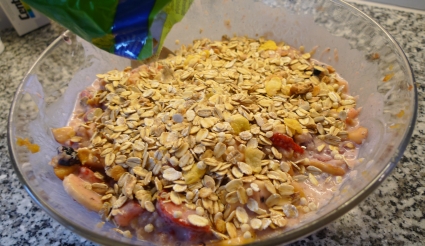
I add the cereal flake mix only right before serving. I like my muesli not only to be smooth but also crunchy at the same time. I use a mix with no added sugar and no dried fruits.


Serve and enjoy. It goes well with a piece of bread and butter and a coffee with milk. If you like to have your food with some wine, Toño recommends a Moscato d'Asti.

Monday, July 13, 2009

Charlotte Russe - The Recipe

Charlotte Russe is the sister dessert of Charlotte Royal. This dessert had been invented by the French chef Marie Antoine Carême (1784-1833), who named it in honour of his Russian employer Czar Alexander I (Russe is French for Russian). The Charlotte Russe can't deny its Russian heritage. It clearly resembles both an Ushanka and a Papakhi.
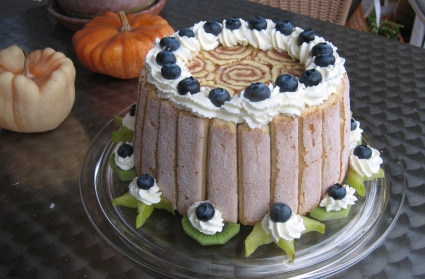


This recipe serves 10.

Jam/Jelly Roll

The dessert is covered in slices of jam rolls on the top and on the bottom.

Ingredients:
4 eggs, yolk and white separated
120 g sugar
1 pinch of salt
2 tbs of warm water
zest of half a lemon
80 g flower
4 tbs of raspberry jam (jelly)

Cream egg yolk, sugar and the pinch of salt until the the mass is bright. Add the lemon zest. Put the whipped egg whites on top and sieve the flower onto it. Fold the flower and egg whites carefully under the mass. Put baking paper on a rectangular baking sheet and evenly spread the mass onto it (approx 1 cm thick). Bake it for 8-10 minutes at 220°C/428°F. Topple the biscuit onto a kitchen towel, remove the baking paper carefully and cover it with the baking sheet to let it cool down.

Spread a thin layer of strawberry jam onto the biscuits and roll them tightly to about 3 cm thick rolls. Cover them with baking paper and put for half an hour into the deep freezer.

Building

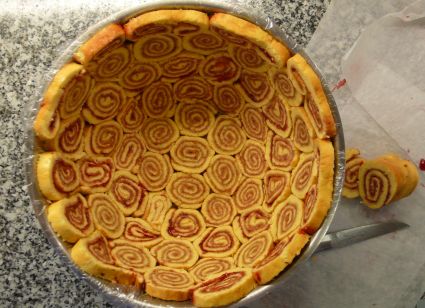
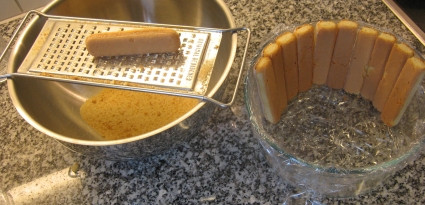
The next stage of this dessert requires more the qualities of a mason than of a pastry cook. You have to arrange ladyfingers seamlessly in a 2.5 litre mould, which involves a lot of accurate rasping.


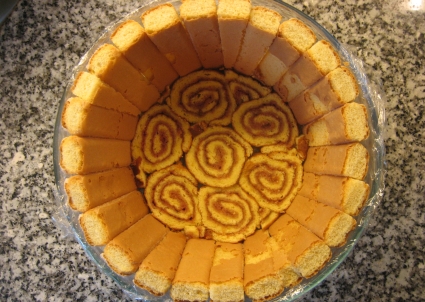
Now tightly put in the raspberry jam rolls for the top in the bottom of the mould.


Bavarian Cream

The heart of a Charlotte is made of Bavarian cream. This is basically a Crème Anglaise made of sugar, egg yolks and hot milk, which is flavoured with vanilla. In addition, it is thickened with gelatin, lightened with whipped cream, and flavoured with liqueur. Good bye waistline.

There is hardly any procedure, besides of deep-frying, which is not used to produce this. You have to boil, to whip, to bring close to a boil and in the end, you have to whip it in a deep silver dish which is surrounded with crushed ice, as Escoffier recommends.

Ingredients:
385 g milk
1 vanilla pod
1 pinch of salt
80 g egg yolk
135 g sugar
12 g gelatine
385 g cream
25 g Maraschino

For the Charlotte Royal one is supposed to use cherry brandy (Kirsch), for the Charlotte Russe Maraschino (Marasca cherry cordial) is used. Of course, we have both on stock - the Kirsch though is home-distilled by my clan.
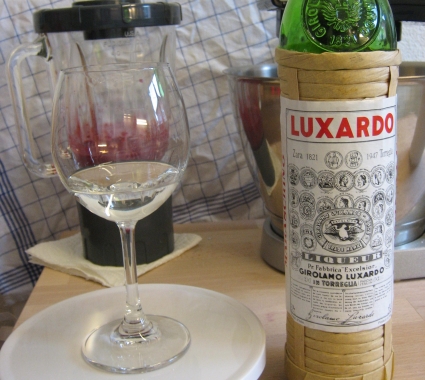


Preparation:
- let gelatine swell in cold water
- whip the cream and put it into the fridge
- Slice the vanilla pod with a knife and scratch out the content.

Bring milk, vanilla pod and the pinch of salt to a boil. Remove the vanilla pod. Cream egg yolk and sugar in a bowl. Add the milk while stirring. Pour the mixture back into the pan, keep stirring and bring close(!) to a boil. The poetic German term for this is heat to the rose. So if you see roses, it's hot enough.

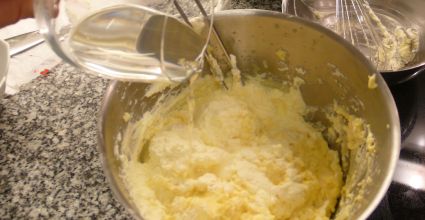
Remove from the stove and pour mass into a bowl. Dissolve the squeezed gelatine in it and pass through a sieve into metal bowl. Put it into ice or iced water, keep stirring and let it cool down. As soon as it starts to thicken, fold in the whipped cream and the Kirsch.

Pour the cream into the mould and cover the bottom with the remaining slices of jam roll. Put into the fridge to solidify.
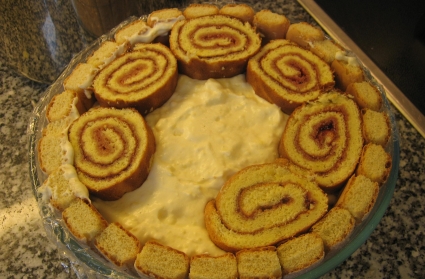


Raspberry Cream

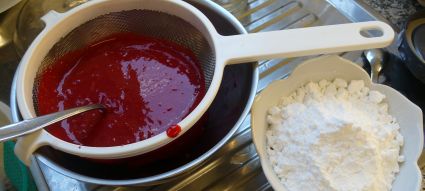
Charlottes are best served on some raspberry cream. While the mass solidifies, we have time to prepare the cream. At least this is an easy step, but has to be done on time, because it tasted better when the cream is chilled.

Ingredients:
325 g raspberries
165 g icing sugar
10 g lemon juice

Blend dead ripe raspberries, pass them through a tight sieve, add some lemon juice and icing sugar. Chill it gently.


Trimming

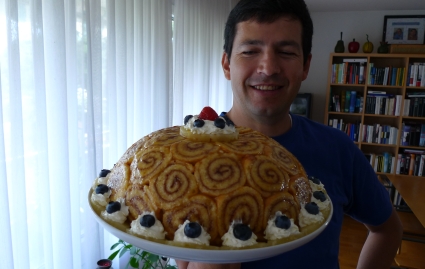
When the mass has solidified comes the dangerous topsy-turvy part which should put the Charlotte into the perfect position onto the serving plate. Now trim it at your discretion (for inspiration see picture on top). Done. Enjoy!

Sunday, July 12, 2009

Charlotte Royale - The Recipe

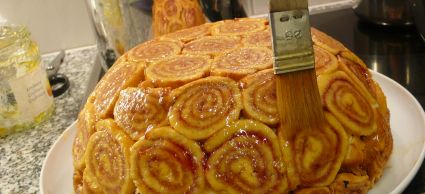
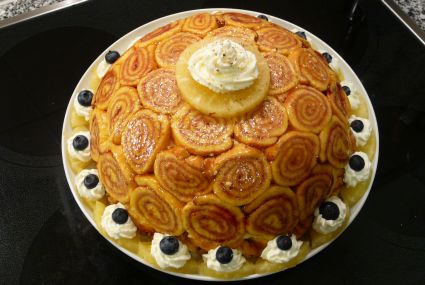
Charlotte is a classical dessert with its origins in the 19th century. There are various variants of Charlottes. I here concentrate on the Charlotte Royale. It is quite spectacular, however requires about 6 hours in the kitchen. The recipe here serves 15 and will look like this:


Jam/Jelly Roll

The dessert is covered in slices of jam rolls.

Ingredients:
8 eggs, yolk and white separated
120 g sugar
1 pinch of salt
4 tbs of warm water
zest of a lemon
160 g flower
8 tbs of raspberry jam (jelly)

Cream egg yolk, sugar and the pinch of salt until the the mass is bright. Add the lemon zest. Put the whipped egg whites on top and sieve the flower onto it. Fold the flower and egg whites carefully under the mass. Put baking paper on two rectangular baking sheets and evenly spread the mass onto them (approx 1 cm thick). Bake it for 8-10 minutes at 220°C/428°F. Topple the biscuit onto a kitchen towel, remove the baking paper carefully and cover it with the baking sheet to let it cool down.

Spread a thin layer of strawberry jam onto the biscuits and roll them tightly to about 3 cm thick rolls. Cover them with baking paper and put for half an hour into the deep freezer.

Cover the insight of a ball shaped mould (content 4 litres) with clingfilm. Cut the roll into 5 mm thick slices and cover the insight of the mould tightly with them. Keep some for the bottom in the fridge.


Bavarian Cream

The heart of a Charlotte Royale is made of Bavarian cream. This is basically a Crème Anglaise made of sugar, egg yolks and hot milk, which is flavoured with vanilla. In addition, it is thickened with gelatin, lightened with whipped cream, and flavoured with liqueur. Good bye waistline.

There is hardly any procedure, besides of deep-frying, which is not used to produce this. You have to boil, to whip, to bring close to a boil and in the end, you have to whip it in a deep silver dish which is surrounded with crushed ice, as Escoffier recommends.

Ingredients:
615 g milk
1.5 vanilla pod
1 pinch of salt
128 g egg yolk
215 g sugar
19 g gelatine
615 g cream
40 g cherry brandy (Kirsch)

Preparation:
- let gelatine swell in cold water
- whip the cream and put it into the fridge
- Slice the vanilla pod with a knife and scratch out the content.

Bring milk, vanilla pod and the pinch of salt to a boil. Remove the vanilla pod. Cream egg yolk and sugar in a bowl. Add the milk while stirring. Pour the mixture back into the pan, keep stirring and bring close(!) to a boil. The poetic German term for this is heat to the rose. So if you see roses, it's hot enough.

Remove from the stove and pour mass into a bowl. Dissolve the squeezed gelatine in it and pass through a sieve into metal bowl. Put it into ice or iced water, keep stirring and let it cool down. As soon as it starts to thicken, fold in the whipped cream and the Kirsch.

Pour the cream into the jam roll layered mould and cover the bottom with the remaining slices of jam roll. Put into the fridge to solidify.


Raspberry Cream

Charlotte Royale is best served on some raspberry cream. While the mass solidifies, we have time to prepare the cream. At least this is an easy step, but has to be done on time, because it tasted better when the cream is chilled.

Ingredients:
325 g raspberries
165 g icing sugar
10 g lemon juice

Blend dead ripe raspberries, pass them through a tight sieve, add some lemon juice and icing sugar. Chill it gently.


Abricoture

When the mass has solidified comes the dangerous topsy-turvy part which should put the Charlotte into the perfect position onto the serving plate. When that went well, brush some abricoture onto the surface to give it a shiny appearance. To get the apricoture, I heat some apricot jam in a pan and pass it through a sieve.


Decoration

Now the final trimming at your discretion.


Done. Enjoy!