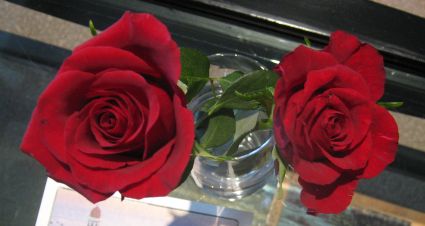
I've got those roses with my laundry. The hotels of the Taj group put a rose onto every basket with the washed, ironed and nicely packed undies and shirts. Yesterday, I was in my room when a couples of baskets were delivered. I took the roses, put them into a water glass and got myself a medium to be with Toño. Then I know, that there are certainly some flowers in our resident as well as at Toño's office.
Since I'm not a poet at all, I have to resort to Pablo Neruda, a master of this art, who wrote the “The Herbalist’s. Rose,” devoted to flowers, branches, and vegetal growth:
La rosa del herbolario
Dejo en la nave de la rosa
la desición del herbolario:
si la estima por su virtud
o por la herida del aroma:
si es intacta como la quiere
o rígida como una muerta.
La breve nave no dirá
cuál es la muerte que prefiere:
si con la proa enarbolada
frente a su fuego victorioso
ardiendo con todas las velas
de la hermosura abrasadora
o secándose en un sistema
de pulcritud medicinal.
El herbolario soy, señores,
y me turban tales protestas
porque en mí mismo no convengo
a decidir mi idolatría:
la vestidura del rosal
quema el amor en su bandera
y el tiempo azota el esqueleto
derribando el aroma rojo
y la turgencia perfumada:
después con una sacudida
y una larga copa de lluvia
no queda nada de la flor.
Por eso agonizo y padezco
preservando el amor furioso
hasta en sus últimas cenizas.
The herbalist's rose
I consign to the ship of the rose
an herbalist's decision:
whether to honour the rose for its strenght,
or the wound of its odor:
whether all is intact, as he likes it,
or stiff as a corpse.
The terse ship will not say
which death it prefers:
the prow thrusting itself
through victorious fire
crowding its sails and ablaze
in its clustering beauty,
or wilting away under its regimen
of medicinal comeliness.
I am that herbalist: friends,
flinching from every complaint
because I can never agree
how to resolve my idolatry:
the rose's investiture
burns love on its banners,
time flays from its skeleton
the juice of a scarlet aroma,
the perfume's tumidity:
then, with one blow of the weather,
a great cupful of rain,
nothing is left of the flower.
Here I am moping and mowing
to preserve the full fury of love
till the last ash flickers out.